Who Owns the Past? The Tension Between State Preservation and Local Agency in Sweden
As Sweden shifts from top-down heritage management to community-led narratives, how does the state balance national identity with local autonomy?
- The Swedish National Heritage Board is the primary agency for managing national historic environment policy [1].
- The Historic Environment Act (1988:950) provides the legal framework for the protection of historic buildings and ancient remains in Sweden [2].
- Swedish cultural policy is transitioning toward a more inclusive model that recognizes local and subjective heritage narratives [3].
- Letters of allocation to Swedish heritage agencies increasingly focus on culture as a catalyst for societal development [4].
- The Swedish Local Heritage Federation acts as a primary hub for grassroots participation in heritage preservation [5].
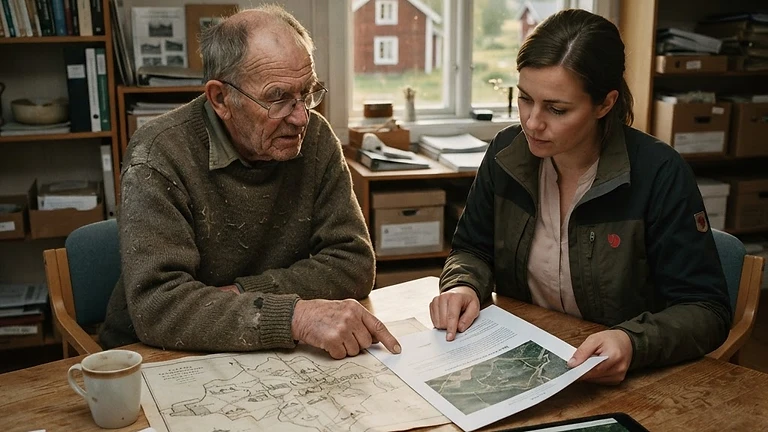
Who Owns the Past? The Tension Between State Preservation and Local Agency in Sweden: editorial illustration for NATION CONTINUITY.
The Centralized Custodianship
In Sweden, the stewardship of history has traditionally been a centralized endeavor. According to the Assignment of the Swedish National Heritage Board (Riksantikvarieämbetet), the state agency serves as the central administrative authority for cultural heritage, tasked with promoting the preservation and sustainable use of historical environments [1]. This top-down structure, largely codified in the Historic Environment Act (1988:950), grants the state powers to protect ancient remains and historic buildings of national interest [2]. For decades, this framework ensured a uniform standard of protection across the nation, positioning the state as the sole arbiter of what constitutes heritage worthy of public resources.
The Shift Toward Inclusion
The contemporary landscape, however, is witnessing a paradigm shift. The Compendium of Cultural Policies and Trends notes that Swedish policy is evolving from static, expert-driven conservation toward a broader, more inclusive 'heritagization' [3]. This change is reflected in the administrative shift observed in letters of allocation to heritage agencies, which increasingly emphasize the role of culture in societal development rather than mere physical upkeep [4]. By prioritizing the social value of cultural heritage, the state implicitly acknowledges that history is not a static object to be guarded, but a dynamic resource to be utilized.
The Friction of Agency


This transition has introduced significant friction between bureaucratic mandate and local agency. The Sveriges Hembygdsförbund (Swedish Local Heritage Federation) represents a massive network of local historical societies, serving as a primary site for this tension [5]. While the state focuses on the legal preservation of structures under the 1988 Act, local communities often prioritize the subjective, living memory of their neighborhoods and landscapes [2, 5]. When a state agency designates a site as 'nationally significant,' it may override local planning priorities, creating a clash between national identity projects and local autonomy [3, 4].
The Balancing Act
Can a centralized state effectively delegate heritage ownership? Current evidence suggests that the state remains committed to its regulatory role, using legislative tools to maintain oversight [2]. However, the inclusion of local narratives is now treated as a policy requirement rather than an optional add-on [3, 4]. The challenge lies in harmonizing the rigid requirements of the Historic Environment Act with the grassroots impulse for self-determination [2, 5]. Recent shifts in agency allocation suggest that top-down directives are increasingly flavored with demands for collaborative governance, though the final authority remains firmly in the hands of the state [4].
Conclusion
The question of who owns the past remains at the core of the Swedish heritage discourse. While the state possesses the legal instruments of ownership, the cultural value of the past is being increasingly contested at the local level. As Swedish policy continues to integrate community-led narratives, the relationship between central management and local agency will define the future of the nation's historical landscape.
Sources & Further Reading
- [1] Riksantikvarieämbetet. (2013). Assignment of the Swedish National Heritage Board.
- [2] Riksantikvarieämbetet. (1988). Historic Environment Act (1988:950).
- [3] Compendium of Cultural Policies and Trends. (2024). Country Profile Sweden.
- [4] Taylor & Francis Online. (2024). From party politics to governing instruments: an analysis of letters of allocation to the Norwegian and Swedish heritage agencies.
- [5] Sveriges Hembygdsförbund. (2018). About the Swedish Local Heritage Federation.
Sources provide the legal framework (1988:950), institutional purpose, and the policy-oriented shift toward inclusive heritage practices as analyzed in recent academic reviews.
The NATION CONTINUITY Editorial Desk produces AI-assisted editorial content — research, drafting and media generated under the publication's source, quality and discovery standards, then reviewed before publication.