Ghana: When Culture Becomes a Development Strategy
Cultural assets can support jobs, tourism, design, music, film and international visibility.
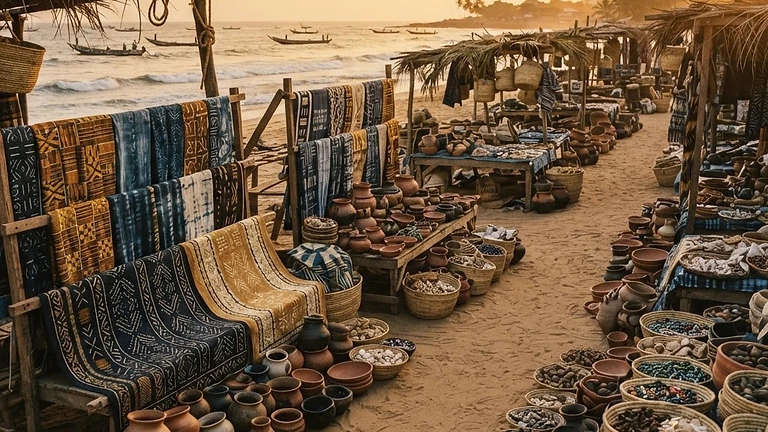
West African coastal market scene at golden hour
In 2019 Ghana ran a campaign that most cultural ministries would have treated as a commemoration and ran it instead as an economic programme. The Year of Return marked four centuries since the first recorded arrival of enslaved Africans in colonial Virginia, and it invited the descendants of that dispersal to come to Ghana.
They came. Arrivals rose sharply, hotels filled, the diaspora tourism sector expanded, and a number of visitors did what the programme had quietly been designed to encourage: they applied for citizenship, bought property, or started businesses. Ghana followed it with Beyond the Return, a decade-long framework extending the same logic past the anniversary.
What makes this worth analysing is not the marketing. It is the underlying decision to treat a historical relationship as an asset with a return on investment.
The pieces Ghana already had
The programme worked because the inputs existed.
The sites. The forts and castles of the Ghanaian coast - Cape Coast, Elmina and others - were inscribed on the UNESCO World Heritage list in 1979. They are among the most significant physical remains of the transatlantic slave trade anywhere, and they had been maintained, interpreted and staffed for decades by the Ghana Museums and Monuments Board.
The policy framework. The National Commission on Culture had existed since the 1990s, and Ghana adopted a formal Cultural Policy in 2004 that explicitly connected cultural resources to national development rather than treating them as heritage to be conserved in isolation. The 2019 campaign was an application of an existing doctrine, not an improvisation.
The material culture. Kente - the strip-woven cloth of the Asante and Ewe traditions, with patterns carrying names and meanings - and the Adinkra symbol system give Ghana a visual language that is instantly identifiable internationally and, unusually, still produced by working weavers and printers rather than reproduced industrially from an archive.
The contemporary sector. Highlife, hiplife and Ghana's role in the wider West African music economy provide a living creative industry rather than a heritage display. Culture-as-development is far easier to argue when the culture in question is currently generating revenue.
The mechanism, stated plainly
Ghana's model connects four things that are usually managed by four unconnected departments.
Heritage sites create a reason to travel. Diaspora relationship converts travellers into repeat visitors and sometimes residents. Citizenship and investment pathways convert residents into capital. Creative industries provide the contemporary content that keeps the country visible between anniversaries.
Each element strengthens the others. That is what distinguishes a strategy from a campaign, and it is the part other states most often fail to copy - they run the campaign and omit the pathways.


What the coastal sites are being asked to do
The forts deserve separate attention, because they carry an unusual double burden.
They are simultaneously sites of atrocity and drivers of a tourism economy. The Door of No Return at Cape Coast is a memorial, a pilgrimage destination and a photographed attraction, and these functions do not sit together comfortably. Interpretation has to serve visitors arriving to mourn ancestors, Ghanaian schoolchildren studying national history, and international tourists with no personal connection - three audiences with incompatible needs standing in the same room.
Ghana has handled this better than most comparable sites, largely because interpretation has been developed locally over decades rather than imported. But the tension is permanent, and it intensifies as visitor numbers rise. Heritage that generates revenue is under continuous pressure to become more comfortable, and the point of these particular sites is that they should not be.
Where the strategy strains
Three further difficulties are visible, and Ghanaian commentators raise all three.
Distribution. Tourism revenue concentrates geographically and sectorally. Hotels, airlines, tour operators and property markets in Accra and along the coast capture most of it; the weaving communities whose cloth supplies the visual identity capture considerably less. Cultural development that does not reach the producers of the culture is development of something else.
Authenticity under commercial pressure. Kente's international recognition has produced a large market in printed imitation cloth, much of it manufactured outside Ghana, which competes directly with hand-woven production on price. A hand-woven cloth takes days of skilled labour; a printed approximation takes minutes of machine time. The visibility that the strategy generates is the same visibility that makes counterfeiting profitable, and no purely national instrument can address a global market in imitation. This is a general problem for heritage-as-economy, and Ghana is a clear case of it.
Expectation management. Diaspora return involves people arriving with a relationship to a place formed at a distance, sometimes over generations. The encounter between that relationship and everyday Ghanaian life - bureaucracy, land disputes, differing assumptions about belonging - does not always resolve comfortably. Ghanaian and diaspora writers have discussed this at length, and the programme's long-term success depends on it being handled honestly rather than promoted past.
Language, the piece least developed
One element of Ghana's cultural infrastructure lags the others. Ghana has a large number of indigenous languages, several with millions of speakers, and English remains the official language and the medium of most formal education beyond the earliest years.
Policy has fluctuated on how long instruction in a Ghanaian language should continue before the switch to English, and the practical result is that the languages carrying the country's oral, musical and proverbial traditions occupy less institutional space than the visual and performing culture the development strategy promotes. A model that monetises heritage effectively while under-resourcing language is protecting the more exportable half of its inheritance.
Why this case matters beyond Ghana
Because it reframes the argument that cultural continuity is a luxury good.
The standard objection to spending on culture in a lower-income country is opportunity cost: money spent on heritage is money not spent on clinics. Ghana's answer is not to deny the trade-off but to dispute the premise - to treat cultural assets as productive capital that generates employment, foreign exchange and investment, and therefore to place them in the development budget rather than the ceremonial one.
That argument is available to a great many countries with underused heritage and an emigrant population. What Ghana adds is the demonstration that it requires infrastructure - maintained sites, a policy framework, citizenship pathways, a functioning creative sector - assembled before the campaign, not after it.
There is a final condition, and Ghana meets it in a way that is easy to miss. The strategy works because the country is politically stable enough for a ten-year framework to survive changes of government. Beyond the Return was designed to run across administrations, and cultural investment of this kind cannot pay back inside a single electoral cycle. Brazil's experience of a ministry abolished and restored within four years is the counter-case: the same policy instruments produce nothing if the institution operating them is periodically dismantled.
Ghana National Commission on Culture; Cultural Policy of Ghana (2004); Year of Return (2019) and Beyond the Return programme documentation; UNESCO World Heritage inscription, Forts and Castles, Volta, Greater Accra, Central and Western Regions (1979); Ghana Museums and Monuments Board; Ministry of Tourism, Culture and Creative Arts; Ghana Statistical Service.
Cultural contributor documenting Ghanaian heritage, Kente, creative economy and Pan-African history.