Europe: Different Nations, Shared Civilisation
United enough to remain different.
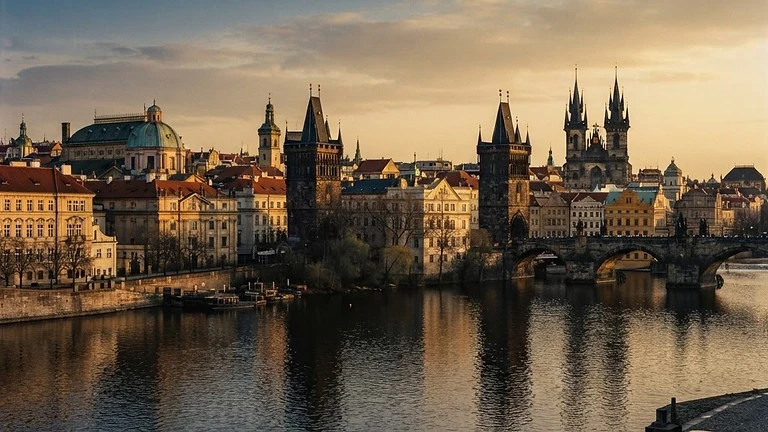
European cityscape blending Gothic spires and classical facades at golden hour
The European Union's motto is United in diversity. Like most mottos it is doing more work than it looks like, because it makes a claim that is not obviously true and that the continent's history repeatedly contradicted: that unity and difference are compatible rather than opposed.
The claim is worth examining properly, because it is the operating assumption of the largest peacetime political construction in European history - and because the honest answer to what do Europeans actually share is more specific, and more interesting, than either the enthusiasts or the sceptics usually allow.
What is not shared
Begin with the negative, because most accounts of European commonality skip it.
Not language. The EU operates in twenty-four official languages. Most belong to the Indo-European family, but Finnish, Estonian and Hungarian are Uralic, Maltese is Semitic, and Basque is unrelated to anything. There has never been a European vernacular. Latin served as a scholarly and ecclesiastical lingua franca for centuries, but it was the language of a literate minority, not of the continent.
Not religious uniformity. The Latin and Greek churches divided formally in 1054, the Reformation divided Western Christendom again in the sixteenth century, and the resulting wars shaped the state system that followed. Europe today includes historically Catholic, Protestant and Orthodox societies, substantial Muslim populations both long-established and recent, Jewish communities with a presence spanning two millennia, and among the world's most secularised populations.
Not political tradition. Some European states have continuous parliamentary histories running back centuries. Others were under dictatorship within living memory - Spain, Portugal and Greece into the 1970s, the central and eastern states until 1989. Some are monarchies, some republics, some federal, some highly centralised.
Not ethnicity, in any usable sense. The idea of a European ethnic identity has no coherent historical referent and does not survive contact with the continent's actual population history, which is one of continuous movement.
Anyone claiming that Europe is united by blood, faith or tongue is describing something that has never existed.
What is shared
Something is nonetheless shared, and it is more specific than values. Four things, each identifiable and each with a documentary history.
Roman law as a common substrate
The most durable European commonality is legal. Roman law - codified under Justinian in the sixth century, rediscovered and taught in the medieval universities from the eleventh - provided a conceptual vocabulary that European legal systems absorbed: contract, obligation, property, inheritance, legal personality, the distinction between public and private law.
The absorption was uneven. The continental civil law tradition took it most directly; English common law developed on a different basis, with judge-made precedent at its centre. But even that divergence is a divergence within a shared conversation. European lawyers from different countries argue about the same categories.
This matters more than it sounds. A shared legal vocabulary is what makes it possible for twenty-seven jurisdictions to write law together at all.
The university and the circulation of scholarship
Bologna is conventionally dated to 1088, Paris and Oxford follow within the century, and the model - a self-governing corporation of scholars, with a curriculum, degrees and the authority to license teaching - spread across the continent.
Its significance for continuity is the mobility. A scholar trained in Bologna could teach in Prague or Salamanca because the curriculum and the language of instruction were shared. European intellectual life was transnational four centuries before the nation-state existed. Erasmus, whose name the EU's student mobility programme borrows, moved between Rotterdam, Paris, Oxford, Leuven, Basel and Turin as a matter of ordinary professional practice.
Printing from around 1450 accelerated this, and did something else: by making texts cheap in vernacular languages, it simultaneously strengthened national literary cultures. The same technology deepened both the shared conversation and the separate ones. That double effect is the pattern of European culture generally.
Christianity as historical infrastructure
Whatever an individual European believes now, the built environment, the calendar, the visual tradition, the musical tradition and much of the ethical vocabulary of the continent were shaped by Christianity over a millennium and a half.


This is a statement about historical formation, not about present belief, and it holds regardless of secularisation. The cathedral is in the town centre. The public holidays follow the liturgical year. The Western musical tradition developed substantially in and around ecclesiastical institutions - notation itself emerged from the need to transmit liturgical chant. Orthodox iconography carries a continuous theological and artistic tradition of comparable depth in the east.
Acknowledging this is not a religious claim. It is the same kind of observation as noting that Arabic poetry shaped the literary sensibility of the Peninsula, or that Confucian institutions shaped East Asian administration.
A codified rights tradition, built deliberately after catastrophe
The fourth shared element is the youngest and the most explicitly constructed.
The Council of Europe was founded in 1949 and adopted the European Convention on Human Rights in 1950, establishing the European Court of Human Rights - a body before which individuals can bring cases against states. Its jurisdiction extends well beyond the EU, across the Council of Europe's much wider membership.
This was not an organic development. It was a deliberate response to what European states had recently done, and it embedded a specific proposition: that there are limits on what a sovereign state may do to people within its jurisdiction, and that those limits are justiciable outside the state. The EU's own Charter of Fundamental Rights, given binding force in 2009, extends the same logic into Union law.
Alongside it, the Council of Europe's European Charter for Regional or Minority Languages, opened for signature in 1992, commits ratifying states to protecting languages that are not the state language. That instrument is directly relevant to this magazine's subject: it is a continental commitment to internal linguistic diversity, made by states that had spent the previous century suppressing it.
The minority-language commitment, tested
The Charter deserves more than a mention, because it is the clearest case of European institutions acting directly on the questions this magazine reports.
Its mechanism is unusual. Ratifying states select which languages they will protect and at what level of commitment, from a menu of undertakings covering education, courts, administration, media and cultural activity. A committee of experts then monitors performance against the commitments the state itself chose.
The design is realistic and it is also its limitation. States commit to what they are prepared to deliver, several significant European states have not ratified it at all, and monitoring produces recommendations rather than enforceable orders. Welsh, Catalan, Frisian, Sorbian, Sami and Romani occupy very different positions across the continent, and the difference owes more to domestic politics than to the Charter.
What the instrument nonetheless established is a European norm: that a state suppressing a language spoken inside it is doing something that other European states have standing to notice. Measured against the linguistic nationalism of the nineteenth and twentieth centuries, that is a substantial reversal.
Diversity as policy rather than tolerance
The EU's most distinctive cultural characteristic is that difference is maintained by design and at expense.
The Union translates and interprets across twenty-four official languages, at substantial cost, because the alternative - designating working languages and letting the others become second-tier - would produce a hierarchy of citizens. Every citizen may address the institutions in their own language and receive an answer in it.
Erasmus, established in 1987, has moved millions of students across borders, on the theory that a year lived somewhere else produces an understanding no curriculum can. The European Capitals of Culture programme, initiated in 1985 on the proposal of Melina Mercouri, rotates continental attention through cities that would otherwise never receive it - including small ones and post-industrial ones.
Schengen removed internal border controls; the euro created a shared currency for a subset of members. Both are integration in the strong sense, and both remain contested precisely because they touch things that felt national.
The missing piece
There is one thing the machinery has not produced, and its absence is the strongest argument the sceptics have.
Europe has no shared public sphere. There is no continental newspaper that Europeans read together, no broadcast debate they watch together, no political conversation conducted in a common language before a common audience. European elections are contested as twenty-seven national campaigns about national questions. A citizen of one member state typically knows little about the domestic politics of another, and encounters it only when it becomes a crisis.
This matters because democratic legitimacy is generally held to require a demos - a public that argues with itself. The institutions exist; the conversation largely does not. Defenders reply that a shared public sphere is not a precondition for shared institutions but a slow product of them, and point to Erasmus generations, cross-border professional networks and the routine mobility of millions as evidence of one forming. The argument is unresolved, and it is the most important open question about the whole construction.
The unresolved arguments
Three others, and none of them is close to settled.
Where the boundary lies. Enlargement debates are, beneath the technical criteria, arguments about what Europe is. The question has no agreed answer, and the absence of one is itself a finding: a civilisation with a fuzzy edge is normal, and the demand for a sharp one is usually political rather than historical.
How much is shared without becoming uniform. Every transfer of competence to the Union provokes the objection that national distinctiveness is being eroded, and the objection is not always wrong. There is no formula establishing the right level.
Whether the demographic future changes the answer. Fertility below replacement across the Union, an ageing population, and growth dependent on migration all raise questions about how the continent's cultural transmission works across generations. As this magazine argues elsewhere, the numbers set constraints and do not determine outcomes - but they do make the question unavoidable, and pretending otherwise concedes the ground to those who would answer it badly.
The thing worth stating plainly
Europe's shared inheritance is not an ethnicity, a language or a faith. It is a set of institutions and habits of mind: a legal vocabulary, a transnational scholarly tradition, a historical formation that is substantially Christian, and a deliberately built rights framework constructed in the aftermath of the continent's own worst behaviour.
That inheritance is genuinely common and genuinely thin. It does not tell a Portuguese and a Finn that they are the same. It tells them they can argue in a shared vocabulary, before shared institutions, about things they will continue to disagree on.
The motto turns out to be accurate, though not in the warm way it is usually read. Europeans are not united despite their diversity, and not by it either. They are united by the machinery they built to make diversity survivable - which is a smaller claim than the rhetoric, and a much more impressive achievement.
Statute of the Council of Europe (1949); European Convention on Human Rights (1950) and the European Court of Human Rights; Charter of Fundamental Rights of the European Union (binding from 2009); European Charter for Regional or Minority Languages (Council of Europe, 1992); EU language regime and the twenty-four official languages; Erasmus programme (1987); European Capitals of Culture programme (1985); Corpus Juris Civilis and the medieval reception of Roman law; University of Bologna (1088) and the medieval university tradition; Eurostat demographic statistics; UN World Population Prospects 2024.
Editor-in-Chief of NATION CONTINUITY. Editorial director of CODICE Ltd., focused on international cultural and demographic analysis.