The Swiss Lesson: Integration Through Rules, Language and Contribution
Open to contribution. Firm on integration.

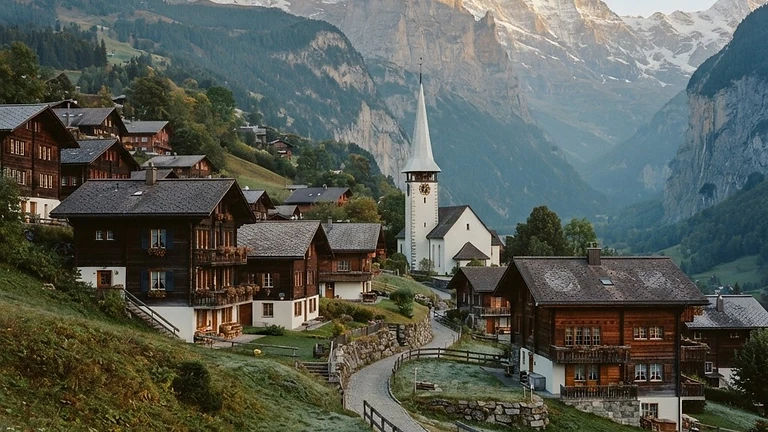
Calm Swiss alpine village with orderly houses and a church spire
Switzerland has one of the highest shares of foreign residents in Europe - roughly a quarter of its population - and one of the lower naturalisation rates. Both facts are consequences of the same system, and understanding why is the point of examining it.
The Swiss model is frequently invoked in European integration debate by people who have not read it. It is invoked as proof that strictness works, and as proof that strictness excludes. It supports both readings, which is what makes it worth setting out properly.
The architecture
Swiss residence runs through a permit ladder. The L permit covers short-term stays. The B permit is the ordinary renewable residence permit. The C permit is settlement - effectively permanent residence, with rights close to those of citizens in most areas other than voting at federal level.
Movement up the ladder is not automatic with time. The revised Foreign Nationals and Integration Act, whose integration provisions took effect at the beginning of 2019, made integration criteria explicit conditions rather than background expectations. Article 58a sets them out: respect for public safety, order and the law; respect for the values of the Federal Constitution; language competence in a national language; and participation in economic life, or acquisition of education or training.
The C permit is normally available after ten years of residence, reduced to five for nationals of countries with which Switzerland has relevant agreements, including EU and EFTA states. Applicants must meet defined language thresholds - expressed against the Common European Framework, with oral competence set above written - and an early C permit is available at five years to those meeting a higher standard.
Citizenship sits above settlement. Ordinary naturalisation requires a C permit and a defined period of residence, and it is decided at three levels: federal, cantonal and communal. The communal level is the distinctive Swiss feature and the most contested - the municipality has a substantive role in assessing whether an applicant is integrated into local life.
The four principles, stated as principles
Stripped of Swiss particulars, the model rests on four propositions that other systems could adopt independently.
Membership is progressive, not binary. There is no single moment at which a person moves from outsider to insider. There is a sequence of statuses, each with its own criteria, each conferring more security than the last. This spreads both the obligations and the reassurance over years.
The criteria are written down. An applicant can read what is required. This is a larger advantage than it appears: systems with vague integration expectations tend to enforce them inconsistently, and inconsistency falls hardest on those least equipped to contest it. Explicit criteria are demanding and auditable.
Language is treated as a precondition for participation, not a test of loyalty. The requirement is calibrated - a threshold sufficient for daily and working life, with speaking weighted above writing. Switzerland's own multilingualism makes the point unavoidable: with German, French, Italian and Romansh as national languages, the national language is necessarily plural, and integration means integration into a linguistic region.
Contribution is part of the definition. Economic participation or education sits among the criteria rather than outside them. This is the element most often criticised and it is also the most consequential: it defines membership as something a person does, not only something they receive.
Federalism as the operative mechanism
The part most often missed in foreign commentary is that Swiss integration policy is not really a national policy.


Cantons run their own integration programmes within the federal framework, funded jointly and adapted to local circumstances - a canton with a large cross-border commuter population faces a different task from a rural one. Communes have a decisive role in naturalisation.
This produces genuine variation in how demanding the process feels depending on where an applicant lives. That is a real inconsistency and a legitimate criticism. It also produces something valuable: decisions taken close enough to the applicant that the assessment is made by people who might actually know them, and a system whose costs are borne by the level of government that has to make it work.
The multilingual dimension compounds this in a way no monolingual state experiences. An immigrant integrating into Geneva and one integrating into Zurich are acquiring different languages, entering different media environments and often different labour markets. There is no single Swiss cultural integration to complete. What holds is a shared political and legal culture, which is thinner than a national culture and, arguably, sturdier for it.
Direct democracy as a constraint
There is a further structural feature that shapes everything above and has no equivalent in most comparators.
Swiss migration and integration policy is subject to direct democracy. Popular initiatives and referendums have repeatedly put migration questions to the electorate, and the results have obliged federal authorities to legislate in directions that would elsewhere have remained a matter for parliament and administration. The 2014 initiative on mass immigration and its difficult reconciliation with Switzerland's agreements with the European Union is the clearest case.
This has two effects, pulling opposite ways. It confers legitimacy: policies that survive a referendum have a mandate that administrative decisions do not, and the explicitness of Swiss criteria is partly a consequence of having to be defensible to voters. It also introduces volatility and, at times, outcomes in tension with international commitments the same country has made.
Any state considering the Swiss approach should note that the explicitness it admires and the direct-democratic pressure it may not want are connected. Criteria get written down partly because the electorate insists on knowing what they are.
The criticisms, in full
A policy paper that only recites the design is advocacy. Four objections are serious.
Communal discretion has produced discriminatory outcomes. Where naturalisation decisions were historically taken by communal assembly or ballot, applicants from particular national origins were rejected at markedly higher rates than others with comparable qualifications, and Swiss research documented this. Procedural reforms and judicial decisions have constrained the most arbitrary forms - reasons must be given, and decisions are subject to appeal - but discretion remains, and discretion carries risk wherever it survives.
The naturalisation rate is low relative to the foreign-resident population. Long-settled residents, and in some cases people born in Switzerland to foreign parents, remain non-citizens for decades. Switzerland has partially addressed the generational case: facilitated naturalisation for the third generation was introduced following a 2017 referendum. But a democracy in which a substantial share of the long-term adult population cannot vote at federal level has a representation problem, whatever the merits of its criteria.
The requirements are not equally costly to meet. Reaching a language threshold while working long hours in a low-wage job, paying course fees and meeting administrative costs, is a heavier burden than it is for a well-paid professional whose employer funds language training. Formally identical criteria can be substantively unequal. Cantonal programmes mitigate this unevenly.
Success may be over-attributed to the model. Switzerland is wealthy, has low unemployment, strong vocational training and a labour market that absorbs newcomers efficiently. A meaningful share of what looks like integration policy success may be labour market success. Transplanting the criteria into an economy with high youth unemployment would likely produce a different result, because the participation in economic life criterion presupposes that participation is available.
What is genuinely transferable
Not the thresholds, and not the communal vote. Three things.
Reciprocity made explicit. The Swiss system states what the newcomer owes and what the state provides in return, at each stage. Many European systems leave both sides implicit, which produces resentment on both sides - newcomers who feel judged against unstated standards, and existing populations who feel that nothing was asked.
Integration as a funded service, not only a requirement. The requirements are matched by cantonal integration programmes, language provision and advisory structures. A requirement without provision is not a policy; it is a filter.
Time as an ally. The progressive ladder assumes integration takes years and builds the timeline into the legal structure, rather than demanding it at the point of arrival and then losing interest.
The Swiss lesson, correctly stated, is not that strictness works. It is that explicitness works, provided it is matched with provision - and that a system this demanding carries an obligation to be scrupulously fair in how it is applied, which Switzerland has not always discharged.
Federal Act on Foreign Nationals and Integration (AIG/LEtr), Art. 58a and integration provisions in force from 1 January 2019; State Secretariat for Migration guidance on L, B and C permits and language requirements; Swiss Citizenship Act and ordinary naturalisation procedure; 2017 referendum and facilitated naturalisation for the third generation; Cantonal Integration Programmes; Fedlex, the Swiss federal legal portal; Swiss Federal Statistical Office population statistics.
Economist studying demographic economics, labour markets and family policy in developed economies.