Morocco: One National Identity, Multiple Historical Layers
A strong national identity built from multiple historical currents.
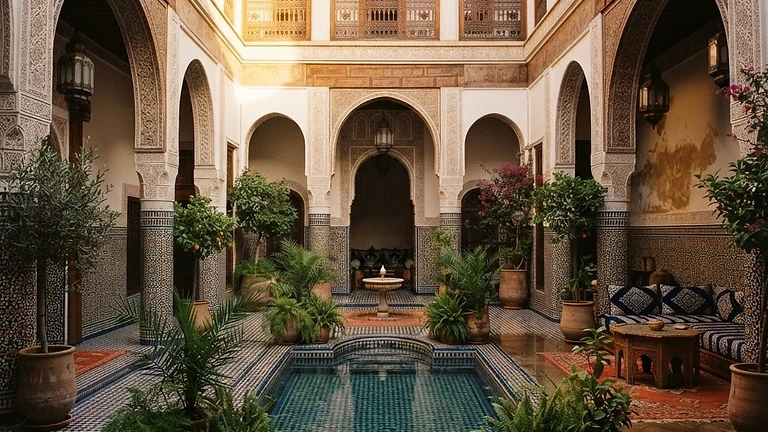
Moroccan riad courtyard with zellige tilework and arches
Most constitutions define the nation by saying what it is. Morocco's 2011 constitution does something rarer: it defines the nation by listing what it is made of.
The preamble describes a national identity forged by the convergence of Arab-Islamic, Amazigh and Saharan-Hassani components, nourished and enriched by African, Andalusian, Hebraic and Mediterranean influences. Seven strands, named in a founding legal text, none of them presented as an exception to the others. For a country that spent the twentieth century under pressure to choose a single register - Arab or Berber, Muslim or Mediterranean, African or Atlantic - the sentence is a deliberate refusal.
It is also, on its own, only a sentence. What makes Morocco worth comparative study is what happened after it.
Language is where the claim gets tested
Article 5 of the same constitution made Amazigh an official language of the state alongside Arabic. That was not a symbolic gesture appended to the text; it was the culmination of a decade of institution-building that began in 2001, when the Royal Institute of Amazigh Culture was created with a mandate to standardise the language and prepare it for public use.
The Institute's first major decision was the hardest one. Amazigh in Morocco is not one language but a family - Tarifit in the north, Tamazight in the Middle Atlas, Tashelhit in the south - and it had been written historically in Arabic script, in Latin script, and in the ancient Tifinagh alphabet. In 2003 the state adopted Tifinagh as the official script.
The choice was contested and remains so. Latin script would have been easier for a generation already typing in it; Arabic script would have integrated more smoothly with existing schooling. Tifinagh did neither, but it did something the alternatives could not: it gave Amazigh a visual identity that was neither borrowed from the coloniser nor absorbed into Arabic. Today the script appears on ministry buildings, national television and road signs - a daily, low-level assertion that the language is not folkloric.
Implementation then took another eight years. The organic law setting out how Amazigh would actually enter administration, courts and schools was adopted in 2019, with a phased timetable running well into the following decade. That gap between constitutional promise and operational law is the honest part of the Moroccan story: officialisation is cheap to declare and expensive to deliver.
The layer that had to be recovered


The Hebraic strand named in the preamble refers to a community that has almost entirely emigrated. Morocco's Jewish population, once among the largest in the Arab world, now numbers in the low thousands. A constitution that names a nearly departed community as constitutive of national identity is making an unusual claim: that a strand of a culture can remain part of the national inheritance after the people who carried it have largely gone.
The claim has been given physical form. Synagogues and Jewish cemeteries have been restored across the country, and Bayt Dakira - the House of Memory - opened in Essaouira in 2020 as a museum and research centre dedicated to Moroccan Judaism. Whether this constitutes genuine continuity or careful curation is a fair question. What is not in doubt is that the state chose to spend money asserting that the layer belongs.
What Morocco does not resolve
Two tensions sit unresolved inside the model, and a comparative magazine should name both.
The first is French. It appears nowhere in Article 5 as an official language, yet it continues to operate as the working language of significant parts of higher education, business and technical administration. A student can pass through Arabic-medium schooling and then find that the university programmes with the strongest employment outcomes are taught in a language the constitution does not recognise. The layered identity is officially seven strands; the functional hierarchy is narrower.
The second is that recognition is not the same as parity. Amazigh is official; it is not yet equally usable in every court, form and ministry, and the timetable for making it so extends years ahead. Some Amazigh cultural organisations argue the phasing is too slow. The state's position is that a language cannot be introduced into administration faster than it can be taught to administrators. Both are defensible; the argument is live.
The strand that gets forgotten
Discussion of Moroccan identity abroad tends to reduce to Arabic against Amazigh, which leaves out the Saharan-Hassani component named alongside them in the preamble.
Hassaniya is an Arabic variety of the Sahara, carrying its own poetry, musical forms and social conventions, and it belongs to a region whose political status has been contested for half a century. Naming it in the constitution is therefore not only a cultural statement. It asserts that the south is constitutive of the Moroccan whole rather than appended to it, which is a claim with obvious political weight and which those disputing Morocco's position in Western Sahara read accordingly.
This is a useful reminder for comparative work generally. Cultural recognition in a constitution is rarely only cultural. Where a state names a regional inheritance as national, it is usually also making a territorial argument, and reporting the first without noticing the second misses what the clause is doing.
Why the case travels
Morocco is useful precisely because it did not choose. The dominant twentieth-century model of nation-building - one people, one language, one narrative - was efficient and, in many places, destructive. Morocco's constitutional method proposes something harder to execute and easier to defend: that a nation can be strong because it is composed, not despite it.
The test is not whether the preamble is beautiful. It is whether the sixth and seventh strands are still legible in fifty years, and whether the child who learns Tifinagh in primary school can use it at thirty in a courtroom. That is a question about budgets, teacher training and administrative software. Continuity usually is.
Constitution of the Kingdom of Morocco (2011), preamble and Art. 5; Royal Institute of Amazigh Culture (IRCAM), founding dahir 2001 and script decision 2003; Organic Law on the official character of Amazigh (2019); Bayt Dakira, Essaouira (2020); Ministry of Youth, Culture and Communication.
Editor-in-Chief of NATION CONTINUITY. Editorial director of CODICE Ltd., focused on international cultural and demographic analysis.