Preserving the Tapestry: Documentation of Indigenous Cultural Heritage in India
Government-led initiatives are currently mapping the diverse linguistic structures, oral traditions, and rock art of India's indigenous communities to ensure cultural memory persists for future generations.
- The North-East India Documentation Project records oral histories of Naga, Bodo, Mizo, and Khasi communities.
- The Adi Drishya Programme documents indigenous languages and ancient rock art forms.
- The Ministry of Culture manages these initiatives to safeguard intangible cultural heritage.
- Documentation efforts aim to capture the dynamic and evolving nature of tribal traditions.
- The 2024 Press Information Bureau report identifies linguistic and artistic preservation as key objectives.
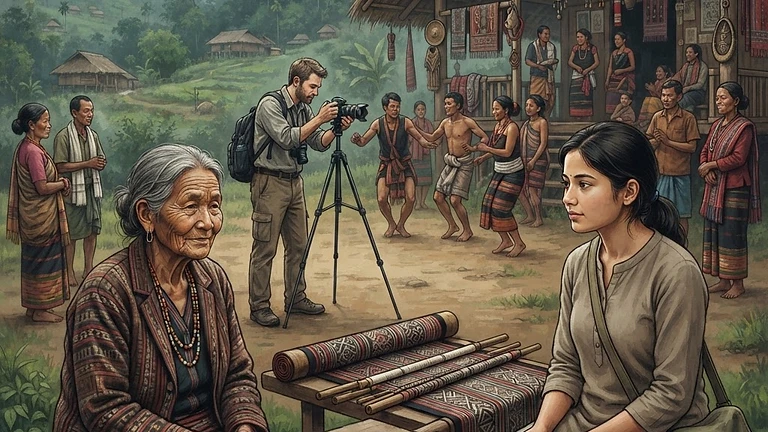
Preserving the Tapestry: Documentation of Indigenous Cultural Heritage in India: AI-generated editorial illustration for NATION CONTINUITY.
The Imperative of Cultural Archiving
Cultural continuity relies on the active preservation of intangible heritage, including linguistic nuances, oral histories, and ancient artistic expressions. In India, recent initiatives led by the Ministry of Culture have focused on systematic documentation to safeguard the knowledge systems of indigenous and tribal communities. By employing digital and ethnographic methodologies, these projects move beyond mere collection, attempting to capture the living and evolving nature of cultural practices across diverse regions.
The North-East India Documentation Project
The North-East India Documentation Project represents a significant shift in how regional histories are recorded. This initiative focuses on the oral traditions, language structures, and social practices of the Naga, Bodo, Mizo, and Khasi communities. According to the Press Information Bureau (2024), the project aims to stabilize knowledge that has traditionally been transmitted through verbal and communal storytelling. By engaging directly with these communities, the project records the variations in dialect and social customs, ensuring that the specific cultural identity of these groups remains accessible even as their practices adapt to contemporary pressures.
The Adi Drishya Programme


Alongside linguistic studies, the Adi Drishya Programme focuses on the material and visual culture of tribal groups, specifically through the documentation of rock art and indigenous language structures. This programme recognizes that art forms are not static relics but are integrated into the daily lives and environments of the people who created them. By cataloging these artistic expressions, the initiative provides scholars and community members with a shared repository of historical and cultural continuity. The programme underscores the importance of viewing these artistic outputs as legitimate, complex systems of communication rather than mere artifacts.
Limitations and Evolving Perspectives
While these state-led efforts provide a robust framework for preservation, the process of documentation itself remains subject to ongoing dialogue. Critics and community scholars often highlight the challenge of reducing dynamic, lived experiences into fixed digital archives. There is a constant negotiation between the institutional need for classification and the fluid, community-held nature of oral history. These projects are characterized not by a single, finished outcome, but by an ongoing effort to bridge the gap between archival science and the actual, lived heritage of India's diverse populations.
Sources
Preservation of Indigenous Languages and Cultural Heritage — Press Information Bureau, Government of India (Ministry of Culture), 2024. https://pib.gov.in/Pressreleaseshare.aspx?PRID=2101347
Press Information Bureau, Government of India — Preservation of Indigenous Languages and Cultural Heritage
The NATION CONTINUITY Editorial Desk produces AI-assisted editorial content — research, drafting and media generated under the publication's source, quality and discovery standards, then reviewed before publication.