The Two-Hour Threshold: Evaluating Serbia’s Minority Language Education Policy
A critical analysis of why the 'Mother tongue with elements of national culture' model fails to meet European Charter standards.
- Serbia employs a 'Mother tongue with elements of national culture' model limited to two hours per week.
- The European Charter for Regional or Minority Languages (ECRML) identifies significant gaps in Serbian educational practice.
- Current pedagogical methods focus on rote learning rather than developing bilingual academic proficiency.
- UNESCO 2018 reporting indicates that legislative access does not equate to effective classroom implementation.
- The Council of Europe mandates a shift toward full bilingual models including core STEM subjects.
- Research suggests two hours of weekly instruction is insufficient for communicative competence.
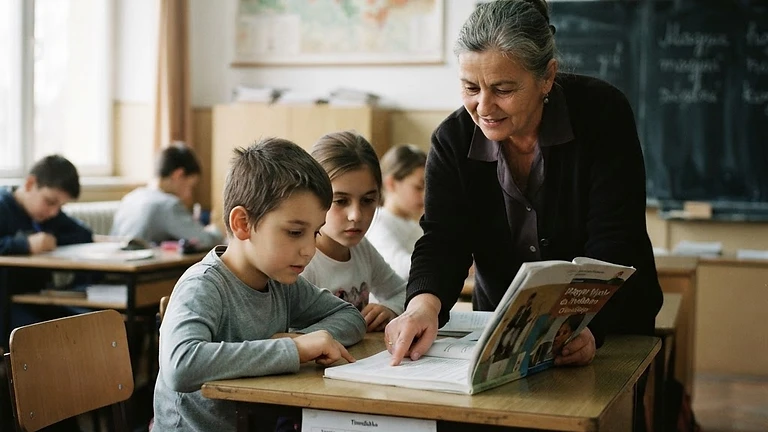
The Two-Hour Threshold: Evaluating Serbia’s Minority Language Education Policy: editorial illustration for NATION CONTINUITY.
The Policy-Practice Gap
The Republic of Serbia maintains a legislative framework governing the rights of national minorities to receive education in their mother tongue. While constitutional protections remain, the delivery of these rights through the 'Mother tongue with elements of national culture' model results in minimal linguistic exposure. According to the Council of Europe's Fifth Evaluation Report (2022), while Serbia has made progress in formalizing minority language rights, there remains a critical need to strengthen the practical application of these provisions in actual educational settings [5]. The data indicates that legal compliance often ignores the functional degradation of language proficiency among minority youth.
The Two-Hour Constraint
The primary structural limitation is the reliance on a two-hour weekly curriculum. Research published by Springer Nature (2026) establishes that this limited exposure is insufficient for achieving communicative competence or academic proficiency in a minority language [2]. By restricting instruction to such a narrow window, the state relegates minority languages to a symbolic subject rather than a medium of instruction. This creates a policy-practice gap where, despite nominal adherence to the European Charter for Regional or Minority Languages (ECRML), students lack the sustained interaction necessary for long-term linguistic continuity.
European Charter Benchmarks


The Council of Europe has consistently reported that while there has been an improvement in the overall minority language situation, significant gaps persist regarding the promotion of these languages in the classroom [3]. The ECRML emphasizes that state parties should foster the teaching of minority languages as an integral part of the school curriculum, not as a supplemental elective [1]. The current two-hour threshold fails to satisfy these recommendations, as it does not integrate minority languages into core educational environments, effectively stalling cognitive development in the learner's first language [5].
UNESCO Standards and Pedagogical Methodology
In its formal reporting on the implementation of conventions against discrimination in education, the Republic of Serbia (UNESCO, 2018) highlighted legislative efforts to ensure equal access to school systems [4]. However, this report acknowledges that the pedagogical methodology often defaults to rote learning and basic cultural identification rather than developing bilingual academic capacity [4]. When contrasted with European bilingual education models, the Serbian approach remains static, lacking the vertical integration required for students to transition from primary through secondary education using their mother tongue as a primary vehicle for learning [2].
The Shift Toward Bilingualism
Surpassing the two-hour threshold requires a fundamental shift in educational philosophy. To meet the standards set by the Council of Europe (2025), Serbia must transition toward bilingual education models that allow for instruction in core subjects—such as mathematics and science—in minority languages [1]. This transition would transform minority languages from external cultural elements into functional tools for academic advancement. Without this structural shift, the current policy risks maintaining a cycle of linguistic decline despite state-level claims of inclusivity [5].
References
- Council of Europe. (2022). Fifth Evaluation Report on Serbia (ECRML).
- Council of Europe. (2023). Serbia: Improvement in minority languages situation.
- Council of Europe. (2025). Need to continue strengthening the use of minority languages in education.
- Springer Nature. (2026). Serbian language policy on the rights to mother tongue education.
- UNESCO. (2018). ИЗВЕШТАЈ РЕПУБЛИКЕ СРБИЈЕ О ПРИМЕНИ КОНВЕНЦИЈЕ.
The article utilizes official evaluation reports from the Council of Europe (2022, 2023, 2025), UNESCO (2018), and peer-reviewed research (Springer Nature, 2026) to substantiate claims regarding pedagogical failure and policy gaps.
The NATION CONTINUITY Editorial Desk produces AI-assisted editorial content — research, drafting and media generated under the publication's source, quality and discovery standards, then reviewed before publication.