The Weaver and the Mask: Caste Roles in Garhwal’s Ramman Festival
In the Garhwal Himalayas, the Ramman festival sustains a complex social architecture through hereditary performance roles and sacred craftsmanship.
- Ramman is a multiform cultural event located in the Garhwal Himalayas.
- Specific castes hold hereditary rights to wear sacred masks during the festival.
- Performance roles are distributed among different groups to ensure community participation.
- Musical accompaniment for the festival includes the Dhol, Damau, and Bhankora instruments.
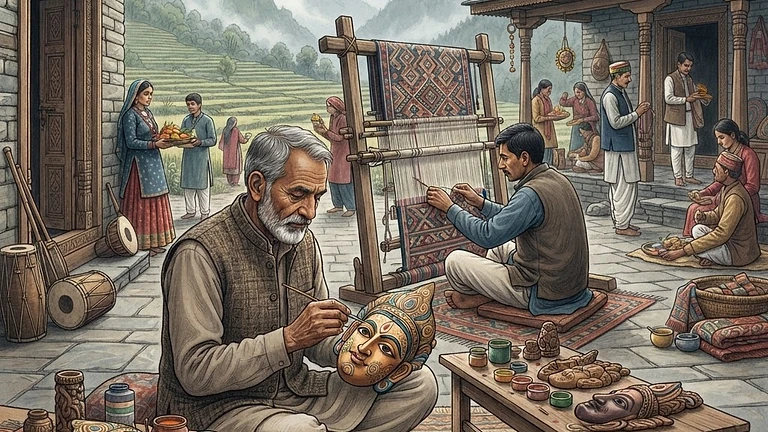
The Weaver and the Mask: Caste Roles in Garhwal’s Ramman Festival: AI-generated editorial illustration for NATION CONTINUITY.
The Ritual Architecture of Ramman
In the high-altitude villages of the Garhwal Himalayas, the Ramman festival stands as a living testament to how social structure and ritual theatre are inextricably linked. According to documentation from UNESCO, Ramman is a multiform cultural event that transcends simple performance, acting instead as a vessel for communal memory. Central to this practice is the distribution of hereditary roles, where specific caste groups are designated as guardians of particular ritual tasks, ranging from the performance of songs to the preservation of sacred masks.
Caste and Performance
The Press Information Bureau of the Government of India notes that each caste and group within the community plays a distinct role in the unfolding of the festival, ensuring that the burden and the honor of transmission are shared across society. These roles are not merely symbolic; they define the mechanics of the event. For instance, specific castes hold the exclusive right to wear sacred masks during the ritual, a practice that highlights the integration of lineage into the artistic fabric of the region.
The Auditory Landscape

The sonic identity of Ramman is maintained by a specialized ensemble. The rhythm and atmosphere of the theatre are driven by instruments including the Dhol, Damau, and Bhankora. The mastery of these instruments is often passed down through familial and institutional channels, serving as an auditory archive of the region's heritage. The precision required to execute these musical duties reflects a broader commitment to maintaining the integrity of cultural practices over generations.
A Living Heritage
While the Ramman festival reflects traditional social divisions, it also functions as an adaptive, evolving institution. By documenting and performing these roles, the participating communities maintain a continuous dialogue between their history and their present. The safeguarding of such festivals provides a window into how Himalayan communities manage identity and social cohesion without relying on uniform cultural models. As practices continue to shift in the face of modern influence, the festival remains a site of active negotiation, illustrating the vitality of intangible heritage in contemporary India.
Sources
- UNESCO: Intangible India! A celebration of the country's incredible intangible cultural heritage (2022).
- Press Information Bureau (PIB), Government of India: Sacred Stages: Traditional Ritual Theatres of India (2025).
UNESCO — Intangible India! A celebration of the country's incredible intangible cultural heritage; Press Information Bureau, Government of India — Sacred Stages: Traditional Ritual Theatres of India
The NATION CONTINUITY Editorial Desk produces AI-assisted editorial content — research, drafting and media generated under the publication's source, quality and discovery standards, then reviewed before publication.