Steeped in Change: The Living Future of Japanese Tea Culture
Traditional tea practices are evolving through local grassroots preservation and modern economic strategies, ensuring that centuries-old crafts survive in a shifting global market.
- The tea ceremony is characterized as a staged continuity of historical roles in Japanese society.
- Contemporary practitioners often use the tea ceremony as a method to invoke and reinforce concepts of Japaneseness.
- Mandokoro tea preservation and Takayama chasen-making are identified as critical local initiatives sustaining the culture.
- Crowdfunding is currently being utilized to replace and renew community factory machines for traditional tea production.
- Regional diversity exists within the tea ceremony, challenging the perception of a singular homogeneous national tradition.
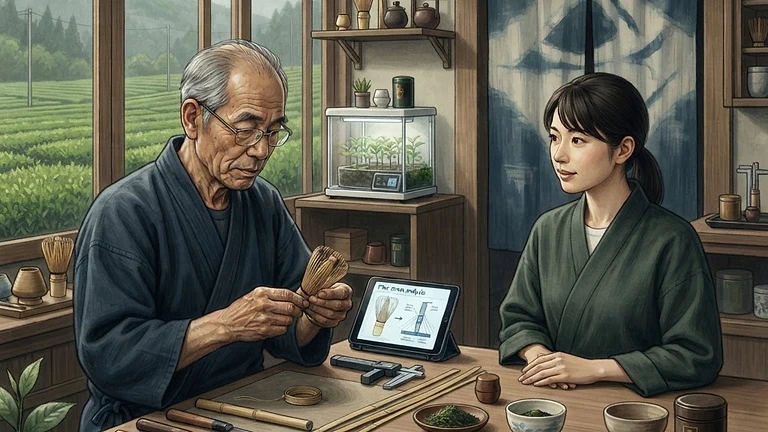
Steeped in Change: The Living Future of Japanese Tea Culture: AI-generated editorial illustration for NATION CONTINUITY.
The Modern Preservation of Tradition
The practice of the Japanese tea ceremony is far from a static relic. Instead, it functions as a dynamic system of ritualized social roles, as documented by Ochanomizu University researchers who note that it serves as a staged continuity of historical engagement in society. While practitioners often invoke concepts of 'Japaneseness' to define their craft, the actual maintenance of this culture relies on a fragile, modern infrastructure that demands constant adaptation.
Sustaining Local Craft Economies
Two primary areas currently defining the evolution of this culture are the Mandokoro tea preservation project and the specialized craft of chasen-making in Takayama. According to the Japanese Tea Report (2025), these local initiatives are essential to the survival of the broader tradition. The delicate art of creating bamboo whisks—the chasen—requires specific regional knowledge that is currently being passed down through community-focused safeguarding efforts.


Economic challenges, however, remain a significant barrier. Aging equipment in traditional tea production facilities has necessitated new approaches to financing. Practitioners have turned to crowdfunding to modernize community factory machines, ensuring that the labor-intensive process of tea processing can remain viable for younger generations. This transition marks a shift where the sustainability of heritage is linked directly to digital and collective financial participation.
Reframing Cultural Continuity
The interpretation of the ceremony remains a site of active discourse. Scholars suggest that the tea ceremony serves as a vehicle for asserting cultural identity, yet this experience is not uniform. The variety of regional tea practices reveals that what is often perceived as a singular national tradition is, in reality, a diverse collection of local arts. By prioritizing the economic survival of craftspeople in areas like Takayama, practitioners are ensuring that the materiality of the ceremony—the physical objects and the specific regional leaves—persists, allowing the ritual to evolve beyond the rigid structures of the past.
Sources
- Global Japanese Tea Association, Japanese Tea Report – August 2025: https://gjtea.org/japanese-tea-report-august-2025
- Ochanomizu University, Making Tea, Making Japan Cultural Nationalism in Practice: https://www.cf.ocha.ac.jp/archive/ccjs/consortia/8th/pdf/8th_consortium_abstract07.pdf
Global Japanese Tea Association — Japanese Tea Report – August 2025; Ochanomizu University — Making Tea, Making Japan Cultural Nationalism in Practice
The NATION CONTINUITY Editorial Desk produces AI-assisted editorial content — research, drafting and media generated under the publication's source, quality and discovery standards, then reviewed before publication.