Brazil: Protecting Culture in a Continental, Mixed Society
National cohesion and internal diversity can coexist — with the right institutions.

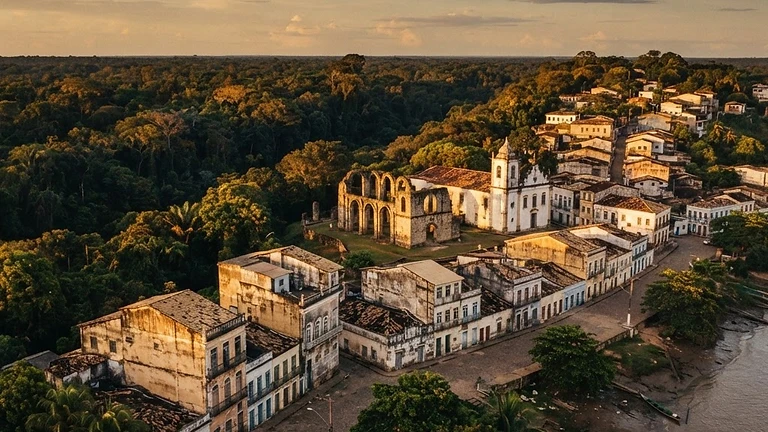
Brazilian rainforest edge meeting colonial architecture at golden hour
Brazil's census asks a question that most national statistical agencies would consider methodologically reckless: it asks people what colour they are, and it accepts the answer.
Since 1991 the cor ou raca question has been answered by self-declaration across five categories - branca, preta, parda, amarela, indigena. No official assigns anyone. No document verifies. The 2022 census produced a result that had been approaching for decades: for the first time, parda, the mixed category, was the largest single group, ahead of branca.
For anyone attempting international demographic comparison, this is a problem. And the problem is the most interesting thing Brazil contributes to the subject.
Why the categories will not translate
The temptation, when building comparative demographic models, is to map national categories onto a common scheme - to treat parda as equivalent to some mixed bucket, preta as equivalent to a Black category elsewhere, and proceed.
Brazil resists this for reasons that are substantive rather than technical.
Parda is not a category of mixed ancestry in the sense used by censuses that record parentage. It is a category of appearance and self-perception, and its boundaries move with education, income, region and political climate. The same person can be recorded differently in successive censuses without having changed. Researchers have documented such reclassification, and rising parda and preta declaration has been read partly as a shift in identification rather than purely in population.
That means the numbers measure something real, but not the thing an international model usually assumes they measure. They measure how a society sees itself at the moment it is asked.
Brazil's own institutions treat this seriously rather than as an embarrassment. The categories are retained because they are needed, while their construction is openly acknowledged. It is a rare example of a statistical system that uses a category and admits its softness simultaneously.
When a soft category carries hard consequences
The softness stopped being purely academic in 2012, when federal legislation established quotas in federal universities and, subsequently, in federal public employment, reserving places by criteria including self-declared colour.
This created an immediate practical difficulty. A category built on self-declaration works well for measuring a population and poorly for allocating a scarce benefit, because it invites contested claims. Brazilian institutions responded by creating heteroidentification commissions - panels that assess whether a candidate's self-declaration is consistent with how they would be perceived socially.
The mechanism is uncomfortable and Brazilians say so. It puts institutions in the position of adjudicating racial identity, which is precisely what the self-declaration model was designed to avoid. It has produced contested decisions and litigation. But the alternative - documentary proof of ancestry - would import a logic Brazil has consistently rejected.
This is worth stating plainly because it is a general lesson rather than a Brazilian peculiarity. Any state that attaches consequences to an identity category will eventually have to decide who belongs to it, and every available method for deciding is bad in a different way.


The institutional architecture
Brazil's cultural machinery is older than most and built in two distinct layers.
The first is the monumental layer. IPHAN, the national historic and artistic heritage institute, was founded in 1937 and is among the oldest bodies of its kind in the Americas. Its early work followed the European model: buildings, colonial towns, churches, objects.
The second layer is where Brazil moved ahead of that model. In 2000 a decree established a national register of intangible cultural assets, creating formal categories for knowledge, forms of expression, celebrations and places. This gave legal standing to practices with no monument attached - the repertoire of an oral tradition, a festival, a technique.
The consequences were concrete. Capoeira, samba de roda, the Cirio de Nazare and frevo among others entered formal protection, and several later reached UNESCO's intangible heritage lists. Practices that had been policed within living memory - capoeira was criminalised in Brazil until the 1930s - became state-protected national assets.
That reversal is the single most instructive fact in the Brazilian record. The same state apparatus that suppressed a practice later registered it as national heritage. Cultural policy is not a neutral instrument applied to a stable object; it is a moving judgement about what counts, and it can move a long way.
A third strand runs alongside: Article 68 of the Transitional Provisions of the 1988 constitution recognises the land rights of quilombola communities descended from escaped and freed enslaved people. Here cultural recognition attaches to territory, which is a far stronger instrument than listing - and correspondingly more contested, with titling slow and frequently litigated.
The instability of the institutions
Brazil's difficulty is not designing cultural institutions. It is keeping them.
The federal Ministry of Culture was abolished as a standalone ministry in 2019, its functions folded into other departments, and re-established in 2023. Between those dates, staffing, budget lines and programme continuity were disrupted, and the National Museum fire of 2018 - which destroyed a large part of an irreplaceable collection amid long-documented underfunding - became the symbol of what discontinuity costs.
This is the honest weakness in the Brazilian model. The legal architecture is sophisticated, internationally admired and, in the intangible domain, genuinely pioneering. Its operation depends on political cycles. A register is only as good as the agency staffed to maintain it.
The indigenous dimension
The 2022 census counted well over a million and a half indigenous people, and Brazil records well over a hundred living indigenous languages - a linguistic diversity comparable to entire continents elsewhere, held inside one state.
Most of these languages have small speaker populations and are under pressure. The instruments that protect an urban festival do not readily apply: what an endangered Amazonian language needs is territorial security, functioning bilingual schooling and documentation, and those depend on land policy and enforcement rather than heritage listing.
Brazil therefore contains, inside a single jurisdiction, both a well-developed apparatus for protecting majority-adjacent popular culture and a much weaker one for protecting the country's most vulnerable linguistic heritage. The gap is not hypocrisy; it reflects that the two problems require different tools.
What Brazil is for, comparatively
Two lessons, and the second is the one this magazine takes seriously.
The first is that intangible heritage protection works. Brazil demonstrated, before the international framework existed, that a state can give legal standing to practice rather than to objects.
The second is a caution about method. Brazil is the standing argument against any comparative demographic model that forces mixed societies into single ethnic categories. When a country's own statisticians tell you that their categories are self-declared, historically contingent and shifting, the responsible response is to report them as that country's own measurement of itself - not to convert them into a variable in someone else's model. Any project claiming to compare populations across borders has to earn the right to do so, and Brazil is where that right is hardest to earn.
IBGE, Censo Demografico 2022, colour or race and indigenous population tables; IBGE self-declaration methodology (from 1991); IPHAN (established 1937); Decree 3.551/2000 establishing the register of intangible cultural assets; Law 12.711/2012 on federal quotas; Constitution of Brazil (1988), ADCT Art. 68; UNESCO intangible heritage inscriptions for Brazilian practices; Ministry of Culture, abolition 2019 and re-establishment 2023.
Economist studying demographic economics, labour markets and family policy in developed economies.