Suma Qamaña: The Aymara Path to Living Well
Across the Andean highlands, Aymara communities are revitalizing ancestral knowledge and agricultural practices to foster sustainable wellbeing.
- Aymara communities in Bolivia, Chile, and Peru share integrated knowledge and rituals for healthy living.
- The Suma Qamaña project is a dedicated effort to safeguard Aymara living heritage.
- Aymara communities utilize specific agricultural technologies tailored to the Andean environment.
- Textile arts serve as a primary repository for Aymara intangible heritage.
- The Aymara language functions as a vital vehicle for transmitting generational knowledge.
- Cultural practices among Aymara communities are dynamic and evolve to address modern challenges.
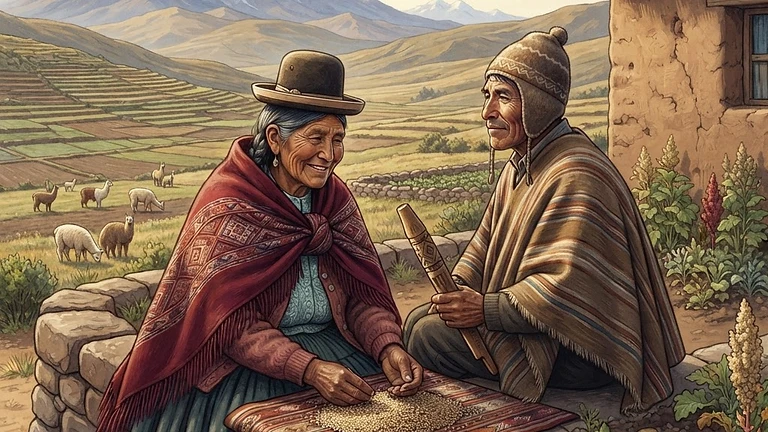
Suma Qamaña: The Aymara Path to Living Well: AI-generated editorial illustration for NATION CONTINUITY.
The Living Philosophy of Suma Qamaña
The concept of Suma Qamaña, often translated as 'living well,' serves as a cornerstone for the cultural identity of Aymara communities across the Andean region. Rather than a static tradition, this philosophy is a dynamic framework that integrates ancestral knowledge, agricultural practices, and social rituals to maintain harmony with the environment and the community. According to the UNESCO Intangible Cultural Heritage records, this living heritage is not confined by modern state borders, but is practiced by communities spanning contemporary Bolivia, Chile, and Peru [1].
Agricultural and Textile Technologies as Cultural Carriers
Central to the transmission of Aymara heritage is the deep link between daily labor and cultural expression. Agricultural technologies, developed over centuries to thrive in high-altitude Andean climates, are maintained as both survival strategies and cultural markers. As documented by Antonio Rodriguez in the UNESCO Multimedia Archives, the mastery of traditional textile arts—often referred to as Tierra de Anacos—functions alongside these farming methods as a primary vessel for historical memory [2]. These crafts are not mere commodities; they are sophisticated systems of symbolic communication that translate environmental knowledge into visual form.
Language and Transmission


The Aymara language acts as a critical vehicle for the continuity of intangible heritage. It is through this linguistic structure that communal values, agricultural cycles, and social protocols are passed between generations. The ongoing UNESCO-supported 'Suma Qamaña' projects focus on safeguarding these practices by ensuring that the oral traditions and technical vocabularies associated with daily life remain active in communal education [1][2]. By prioritizing the transmission of language, these communities ensure that their heritage remains a living, evolving practice rather than a historical artifact.
Diverse Perspectives and Safeguarding
While the 'Suma Qamaña' philosophy is widely shared, practitioners emphasize that it is not a monolithic practice. Instead, it manifests differently depending on local ecological conditions and community-specific histories. The collaborative efforts to document and protect these traditions demonstrate a proactive approach to cultural sovereignty, ensuring that the communities themselves retain control over how their knowledge is applied to modern challenges like food security and climate adaptation. These efforts highlight that indigenous cultural continuity is a deliberate, active process of adaptation and communal commitment.
Sources
- [1] Peru - UNESCO Intangible Cultural Heritage: UNESCO Intangible Cultural Heritage.
- [2] Tierra de Anacos | Intangible Heritage: UNESCO Multimedia Archives.
UNESCO Intangible Cultural Heritage — Peru - UNESCO Intangible Cultural Heritage; UNESCO Multimedia Archives — Tierra de Anacos | Intangible Heritage
The NATION CONTINUITY Editorial Desk produces AI-assisted editorial content — research, drafting and media generated under the publication's source, quality and discovery standards, then reviewed before publication.