Saudi Arabia: Why Arabic Is National Infrastructure
Language as a link between religion, literature, memory and contemporary identity.
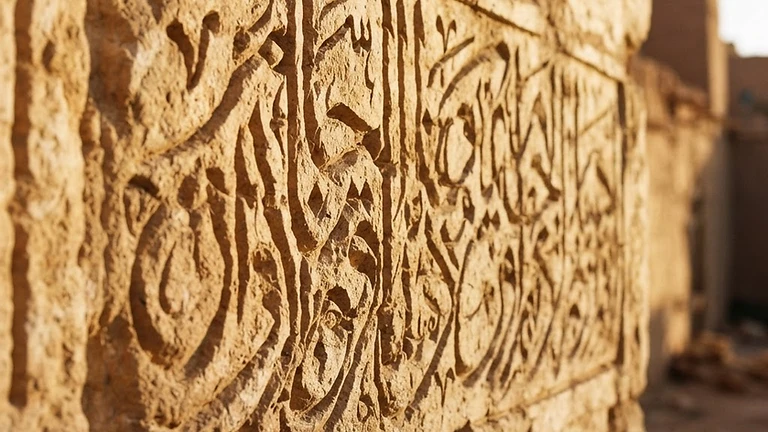
Arabic calligraphy carved into sandstone under golden light
In most countries the national language is treated as heritage: something inherited, valued, and protected by a ministry with a modest budget. In Saudi Arabia, Arabic occupies a different category. It is closer to infrastructure - a system that other systems run on, whose failure would take other things down with it.
The distinction is not rhetorical. It follows from what Arabic in Saudi Arabia is actually carrying.
Four loads on one language
Liturgical. The Qur'an is, in Islamic doctrine, the Arabic Qur'an; recitation and canonical prayer are performed in Arabic by Muslims worldwide regardless of their first language. A state that hosts the two holy mosques and receives millions of pilgrims annually is therefore maintaining a language that has religious standing far beyond its borders.
Constitutional. The Basic Law of Governance, issued in 1992, states that the Kingdom's religion is Islam, that the Qur'an and the Sunna are its constitution, and that its language is Arabic. Language is placed among the state's founding attributes rather than among its cultural assets.
Literary and mnemonic. Classical Arabic poetry constitutes one of the world's longest continuous literary traditions, and in the Peninsula it functions as a repository of lineage, place and event predating written administration. This is not archival material; competitive poetry retains a large contemporary audience.
Administrative and economic. Arabic is the working language of law, government and, through labour-localisation policy, an expanding share of private employment. The Nitaqat programme and successive Saudization measures have progressively raised the proportion of Saudi nationals required in various sectors, which has the second-order effect of moving workplaces that operated in English or South Asian languages toward Arabic.
A language bearing all four loads simultaneously is not in the same position as one bearing only the first or the third.
The institutional turn since 2018
For most of the modern kingdom's history, Arabic's position was secure enough that it required no promotion. That assumption has changed, and the institutional response has been rapid.
The Ministry of Culture was established in 2018 as a standalone body, ending an arrangement in which culture sat inside a ministry principally concerned with information. It has since created a set of sector-specific commissions - literature, translation and publishing among them - giving cultural fields their own budgets and mandates.
The King Salman Global Academy for Arabic Language was established in Riyadh in 2020 with an explicitly international remit: corpus and terminology work, teaching Arabic to non-native speakers, computational resources, and coordination with Arabic language bodies elsewhere. The choice of Global in the name is the policy statement. The Academy is not framed as protecting a national language but as stewarding a world language from its centre.
That claim has a multilateral anchor. Arabic is one of the six official languages of the United Nations, and Arabic Language Day is marked annually on 18 December. A state positioning itself as the language's institutional home is making a bid within an existing international status, not inventing one.


Alongside this, heritage has moved from neglect to investment. Saudi Arabia's UNESCO World Heritage inscriptions now include Hegra, the At-Turaif district in Diriyah, Historic Jeddah, the rock art of Ha'il, Al-Ahsa Oasis and the Hima cultural area; Arabic coffee was inscribed on the intangible heritage list in 2015. Large state-backed development programmes at AlUla and Diriyah have made pre-Islamic and early-Saudi heritage sites into major public projects.
The inclusion of pre-Islamic sites is a substantive shift. Hegra is a Nabataean site, and its promotion as national heritage extends the country's cultural narrative behind the founding of the modern state and behind Islam itself - a widening of what counts as the national past.
What the strategy is actually for
The cultural expansion is not separable from Vision 2030's economic logic, and it is more coherent than a purely diversification-driven reading suggests.
An economy moving away from hydrocarbons toward tourism, entertainment, media and services needs domestic cultural production, and cultural production needs a language with contemporary range - one in which films are scripted, software localised, novels published and technical education delivered. Investment in Arabic is therefore an industrial input, not a subsidy to tradition.
There is also a demographic driver. A very large share of the population is young, and Saudi students and consumers move fluently in globalised English-language digital culture. The institutional build-out is a bid to ensure that Arabic remains a language of contemporary creation for that cohort, not merely of prayer and school.
The tensions worth naming
Two problems are visible and openly discussed within the region.
The first is diglossia - the persistent gap between Modern Standard Arabic, used in writing, broadcasting and formal settings, and the spoken dialects of daily life. Children acquire a dialect at home and encounter the standard variety at school, which affects early literacy. Institutions have long debated how much ground the standard should concede; no Arabic-speaking country has resolved it.
The second is the technical ceiling. English remains dominant in advanced scientific, engineering and medical instruction across much of the region. Translation and terminology programmes address this, but the volume of material required is enormous and continuously growing. A language can hold liturgical and literary prestige while ceding the frontier vocabulary of the sciences - and once ceded, that ground is difficult to recover.
A third, less often stated, concerns audience. Cultural investment on this scale produces institutions quickly; it produces audiences and critical traditions slowly. Museums, festivals and academies can be built in a decade. A publishing ecosystem with independent editors, critics and readers takes longer, and does not respond straightforwardly to funding.
Where the strategy will be judged
The measurable test of the Saudi build-out will not be the number of institutions founded. It will be output that circulates without state involvement.
The relevant indicators are ordinary ones: books published and read outside the country, films that find audiences on their own commercial merits, scholarship cited by researchers who have no relationship with the funder, and a critical press that assesses the work rather than announcing it. These take longer to appear than buildings and cannot be commissioned directly.
There is also a structural question the sector will have to answer. Cultural production that matters tends to include work its own society finds uncomfortable, and a system in which most funding, venues and platforms are state-connected has limited room for that. Every state patron faces this, and several have found workable arrangements. But it is the point at which cultural investment either becomes a culture or remains a programme, and it is too early to say which is happening.
The transferable point
Saudi Arabia is worth reading against Ghana and Japan rather than against its neighbours. All three treat culture as an input to national development rather than as an inheritance to be guarded, and all three have discovered the same thing: that a language or a craft survives on the strength of the institutions built around it, not on the strength of the attachment felt toward it.
Where Saudi Arabia is distinctive is the load-bearing point. Most countries can afford for their national language to become ceremonial. This one cannot.
Basic Law of Governance (1992), Arts. 1 and 7; Ministry of Culture (established 2018) and its sector commissions; King Salman Global Academy for Arabic Language (established 2020); Saudization / Nitaqat labour localisation policy; UNESCO World Heritage inscriptions for Hegra, At-Turaif, Historic Jeddah, Ha'il rock art, Al-Ahsa Oasis and Hima; UNESCO intangible heritage inscription of Arabic coffee (2015); UN Arabic Language Day (18 December); Vision 2030 programme documents.
Cultural analyst writing on Arabic language, Saudi heritage and Vision 2030 cultural transformation.