Paraguay: How Guaraní Became a Living National Language
An indigenous language at the heart of a modern state.
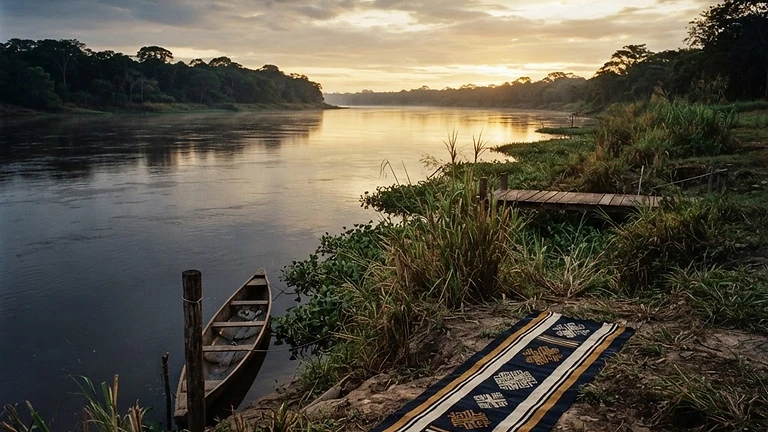
Paraguayan riverbank at dawn with Indigenous woven motifs
There is one indigenous language in the Americas that is spoken every day by a national majority who are not, for the most part, indigenous. It is Guarani, and the fact is strange enough that it deserves an explanation rather than a celebration.
Across the hemisphere, the colonial pattern was consistent: the settler language became the language of state, commerce and advancement, and indigenous languages retreated into rural households, then into old age, then out of use. Paraguay is where that pattern did not hold. A Paraguayan taxi driver, senator and teacher may all switch between Guarani and Spanish inside a single conversation, and the switching carries meaning - Spanish for the formal register, Guarani for the intimate, the humorous, the unmistakably local.
How a language survived contact
The unusual outcome has an unusual history. In the seventeenth and eighteenth centuries, Jesuit missions in the region did what missions elsewhere rarely did: they worked in Guarani rather than against it, producing grammars, dictionaries and printed religious texts. Whatever else the reductions were - and they were also instruments of control - they left Guarani with something most indigenous American languages never acquired: a standardised written form and a body of printed literature.
The second factor was demographic. Paraguay's colonial population was overwhelmingly mestizo, formed through Spanish-Guarani unions, and in those households the language transmitted through mothers was Guarani. The language survived not in a protected enclave but in the majority population's kitchens.
The third factor was war and isolation. Paraguay's nineteenth-century catastrophes and long periods of closure from regional trade slowed the linguistic assimilation that proceeded quickly elsewhere. Survival, here, was partly the product of misfortune.
From tolerated to constitutional
Survival is not the same as status, and for most of the twentieth century Guarani had the first without the second. It was spoken everywhere and taught nowhere; children were punished for using it in classrooms; it carried a persistent association with rurality and low education.
The 1992 constitution changed the legal position decisively. Article 140 declares Paraguay a pluricultural and bilingual country and establishes Spanish and Guarani as official languages. Article 77 goes further into practice, requiring that early education be delivered in the pupil's mother tongue.


Legal status still needed machinery. The Languages Act of 2010 created the Secretariat of Linguistic Policies to implement bilingualism across the state, and established the Academy of the Guarani Language to handle the unglamorous work every functioning language needs - settling orthography, coining vocabulary for administration and technology, issuing authoritative reference works. Guarani also became an official language of Mercosur, moving it into a multilateral setting where it is used rather than described.
The gap between speakers and infrastructure
The honest complication is that a language can be spoken by millions and still be structurally weaker than the numbers suggest.
Guarani's presence in daily speech is not matched by its presence in the places that determine a language's long-term prospects: specialised higher education, scientific publishing, legal drafting, software interfaces, technical documentation. A Paraguayan who wants to study medicine or engineering does so in Spanish. Bilingual education has repeatedly encountered a shortage of teachers trained to teach in Guarani rather than merely to teach about it, and materials for the upper years remain thinner than for the early ones.
There is a further complication that Paraguayans themselves debate. Everyday speech is substantially jopara - a mixed register that borrows freely from Spanish - while the standardised academic Guarani taught in schools is more purist. Some argue that the taught form is so distant from the spoken one that lessons feel like a foreign language; others argue that without a standard, a language cannot enter administration at all. Both positions are serious.
The digital test
The measure that will matter most over the next generation is one the 1992 constitution could not anticipate.
A language now needs a presence in the places where young people spend their attention: interfaces, search, subtitles, social platforms, predictive keyboards, and the machine translation systems that increasingly mediate between languages. These depend on digital corpora - large bodies of text and speech that engineers can train on - and Guarani's corpus is small relative to the number of its speakers, because so much of its daily life has been oral.
Work on Guarani language technology has been under way for some years, in universities and among independent developers, and the Academy's standardisation work is a precondition for it. But the gap is real, and it is a new form of an old problem. A language absent from the tools people use all day becomes, by default, the language they switch out of. Constitutional status does not protect against that. Corpora do.
What the case actually demonstrates
The lesson usually drawn from Paraguay is that indigenous languages can survive modernity. The more useful lesson is narrower and more transferable.
Guarani's position rests on three things that can, in principle, be reproduced: an early written standard, transmission through the demographic majority rather than a protected minority, and eventual constitutional status backed by an implementing institution. What it does not demonstrate is that recognition alone is sufficient. Paraguay had the speakers long before it had the law, and it has the law now while still building the schooling.
For a magazine that reads national cases against each other, Paraguay sits usefully alongside Tanzania. Both made a language that was not the coloniser's into an instrument of national life. Tanzania chose a language belonging to no single group in order to avoid favouring one. Paraguay inherited a language that the majority already shared. Different routes, comparable result: a country where the language of the street and the language of the state are the same.
Constitution of the Republic of Paraguay (1992), Arts. 140 and 77; Ley de Lenguas 4251/2010; Secretaria de Politicas Linguisticas; Academia de la Lengua Guarani; Mercosur language provisions; UNESCO language documentation.
Editor-in-Chief of NATION CONTINUITY. Editorial director of CODICE Ltd., focused on international cultural and demographic analysis.