
France
A centralised republic whose constitutional language policy coexists with recognised regional languages and one of Europe's largest intangible heritage inventories.
Local name: France
Recognised regional or minority languages: Occitan, Breton, Basque, Catalan, Corsican, Alsatian, Flemish
Source labels and dataset codes are those published by the statistical authority named on each row. Figures are reproduced as retrieved, without interpolation.
France (local name: France) is a nation located in Western Europe with its capital in Paris. The official language is French, while several regional or minority languages are recognised under the Council of Europe Charter, including Occitan, Breton, Basque, Catalan, Corsican, Alsatian, and Flemish. The demographic and cultural continuity of the country is defined by a long-standing tradition of centralised state administration, a robust system of social protection that supports family life, and a deeply embedded cultural policy that prioritises the preservation of heritage. Despite recent shifts in demographic trends, such as a declining fertility rate and a negative natural balance, the country maintains a stable population through consistent migration patterns and high life expectancy. These structural elements ensure the persistence of French social and cultural identity within the European framework.
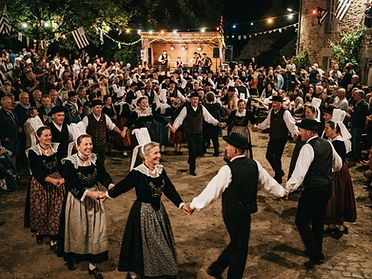
UNESCO Intangible Cultural Heritage: Artisanal know-how and culture of baguette bread · Fest-Noz, festive gathering based on the collective practice of traditional dances of Brittany · Aubusson tapestry · Maloya · Processional giants and dragons in Belgium and France · Cantu in paghjella, a secular and liturgical oral tradition of Corsica · Art of dry stone construction, knowledge and techniques · Skills of Parisian zinc roofers and ornamentalists





Strategy for the Safeguarding of Intangible Cultural Heritage
This policy framework outlines the national commitment to identifying, documenting, and promoting intangible cultural heritage across France. It provides support for local communities to maintain their traditions through financial grants and technical expertise.
- Instrument
- Convention for the Safeguarding of the Intangible Cultural Heritage (ratified by Law No. 2006-763)
- Year
- 2006
- Scope
- France national policy