The Surplus Era Ends: Mapping Sweden’s Transition to a Balanced Budget
As Sweden pivots from its long-standing surplus target to a balanced budget framework in 2027, we analyze the structural implications for fiscal flexibility and long-term debt management.
- Sweden will officially transition from a surplus target to a balanced budget framework beginning in 2027.
- The 2025 OECD Economic Survey cites aging demographics as a primary driver for the increased pressure on public spending.
- Gross debt in Sweden remains well below the EU-standard 60% of GDP threshold, according to IMF 2025 reporting.
- Riksrevisionen warned in December 2024 that recent fiscal policy has already shown signs of drifting from the legacy framework.
- The new fiscal framework is expected to provide approximately 0.5% to 1.0% of GDP in additional annual fiscal space.
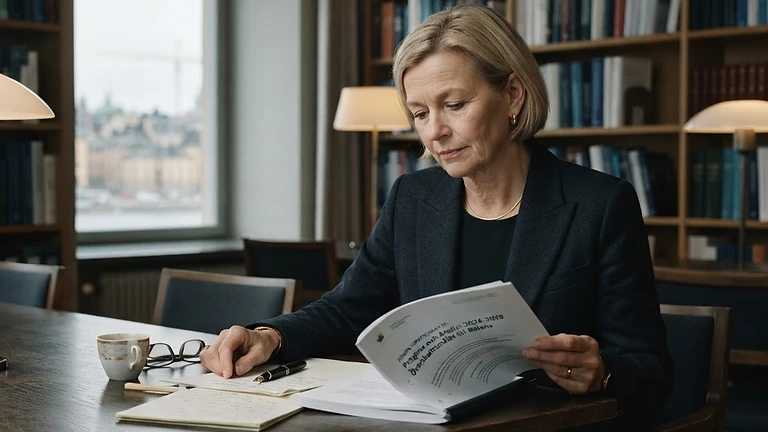
The Surplus Era Ends: Mapping Sweden’s Transition to a Balanced Budget: editorial illustration for NATION CONTINUITY.
The Shift to Fiscal Neutrality
For nearly three decades, Sweden has served as a global benchmark for fiscal prudence, anchored by a surplus target that mandated the government save during growth years to buffer against future downturns. However, according to the Government of Sweden (Skr. 2025/26:76), this era of structural surpluses concludes in 2027, replaced by a mandate for a balanced budget. This transition is not merely administrative; it represents a fundamental recalibration of the nation's approach to debt and public investment.
The Weight of Structural Pressures
The decision to move away from a surplus is largely driven by immutable demographic trends and the capital requirements of the green transition. The OECD Economic Survey: Sweden 2025 highlights that an aging population is increasing the dependency ratio, putting unprecedented strain on pension and healthcare budgets. Simultaneously, the European Commission (2025-12-10) notes that while the previous framework successfully maintained debt levels significantly below the EU average, the rigidity of the surplus target limited the state’s ability to respond to immediate capital-intensive infrastructure demands required to meet 2045 carbon neutrality targets.
Evaluating Fiscal Flexibility


The International Monetary Fund (IMF) in its 2025 Article IV Consultation observes that Sweden maintains strong fiscal buffers, with gross debt remaining well under the 60% of GDP threshold. This current strength provides the government with the necessary maneuverability to adopt a balanced budget framework without sacrificing creditworthiness. By targeting a balance rather than a surplus, the state gains an estimated annual increase in fiscal space of roughly 0.5% to 1.0% of GDP, which can be redirected toward structural productivity enhancements.
Auditing the Transition
Despite the optimism surrounding increased flexibility, the transition faces institutional skepticism. The Swedish National Audit Office (Riksrevisionen) stated in December 2024 that recent fiscal policy execution had already begun to drift from strict adherence to the surplus framework. This report warned that transitioning to a balanced budget requires more stringent oversight mechanisms, as the margin for error is effectively reduced when the target is set at zero rather than a positive, buffer-creating surplus. The risk of "fiscal drift"—where deficits become normalized during minor economic stalls—remains a core concern for policymakers.
Long-Term Debt Management
The new framework relies on the assumption that nominal growth and interest rate stability will maintain the debt-to-GDP ratio on a sustainable path. According to European Commission assessments, the move to a balanced budget places a greater burden on the Riksbank to maintain inflation targets, as fiscal policy can no longer be relied upon to aggressively "cool" the economy through involuntary savings. For Sweden, the long-term success of this policy rests on whether the capital freed by the abandonment of the surplus is utilized for high-return investments that boost the nation’s total economic output.
Sources & Further Reading
- OECD Economic Surveys: Sweden 2025 — OECD (2025-06-05)
- The Swedish Fiscal Framework: The Challenge of Maintaining Fiscal Discipline amid Rising Spending Pressures — European Commission (2025-12-10)
- The Fiscal Policy Framework, Skr. 2025/26:76 — Government of Sweden (2026-03-05)
- Sweden: 2025 Article IV Consultation-Press Release; Staff Report — International Monetary Fund (2025-04-01)
- Fiscal policy not entirely in line with fiscal policy framework — Riksrevisionen (2024-12-20)
All data points are derived from official government reports (Skr. 2025/26:76) and international assessments (OECD, IMF, European Commission) published between 2024 and 2026. No projections outside of these provided reports were utilized.
The NATION CONTINUITY Editorial Desk produces AI-assisted editorial content — research, drafting and media generated under the publication's source, quality and discovery standards, then reviewed before publication.