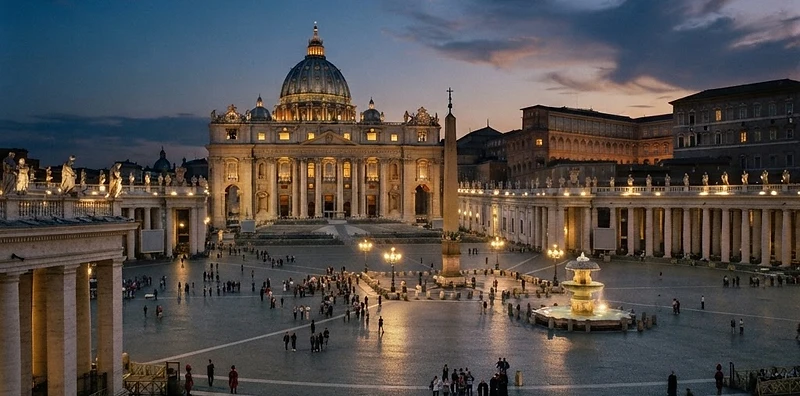
Vatican City
The world's smallest state, whose archival, liturgical and museum continuity reaches beyond any demographic measure.
Local name: Città del Vaticano
Source labels and dataset codes are those published by the statistical authority named on each row. Figures are reproduced as retrieved, without interpolation.
Vatican City, known locally as Città del Vaticano, is an independent sovereign state located entirely within the city of Rome, Italy. It serves as the subregion of Southern Europe and functions as the administrative and spiritual center of the Roman Catholic Church. The state maintains two official languages, Italian and Latin, and has no recognized regional or minority languages under the Council of Europe Charter. Its demographic and cultural continuity is defined by its status as the world's smallest independent nation-state, its unique ecclesiastical elective monarchy, and its role as a repository of global cultural heritage. The state is governed by the Holy See, which exercises absolute executive, legislative, and judicial power. Its population consists primarily of clergy, members of the Pontifical Swiss Guard, and diplomatic personnel, reflecting a highly specialized and transient demographic structure that remains distinct from traditional national populations.
UNESCO Intangible Cultural Heritage: Celebration of the Feast of Saint Peter and Saint Paul

Lateran Treaty Provisions on Citizenship and Residency
This policy regulates the acquisition and loss of citizenship, as well as residency permits within the Vatican City State. It ensures that residency is tied to specific functions and roles within the state, maintaining the demographic stability of the enclave.
- Instrument
- Lateran Treaty
- Year
- 1929
- Scope
- Vatican City national policy