Switzerland
A multilingual confederation where cantonal competence and four national languages make cultural policy a permanent negotiation.
Local name: Schweiz / Suisse / Svizzera / Svizra
Recognised regional or minority languages: Romansh, Yenish, Franco-Provençal
Source labels and dataset codes are those published by the statistical authority named on each row. Figures are reproduced as retrieved, without interpolation.
Switzerland, known locally as Schweiz, Suisse, Svizzera, and Svizra, is a landlocked country situated in the heart of Western Europe. Its official languages are German, French, Italian, and Romansh. Under the Council of Europe Charter, Romansh, Yenish, and Franco-Provençal are recognized as regional or minority languages. The capital is Bern. Switzerland is defined by its unique political structure as a confederated state that grants significant autonomy to its 26 cantons, fostering a high degree of local governance. Its demographic and cultural continuity is anchored by a long-standing policy of neutrality, a robust multilingual identity that integrates diverse linguistic communities, and a highly developed direct democratic system. These structural elements have maintained social cohesion and stability, allowing the nation to preserve its distinct cultural heritage while adapting to the pressures of globalization and significant demographic shifts driven by international migration.
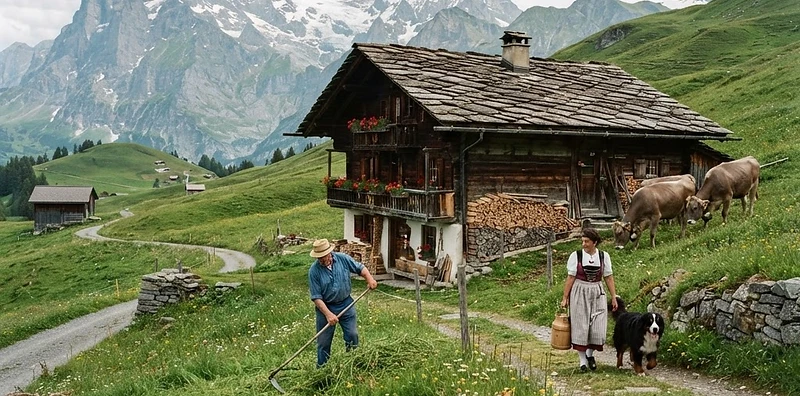
UNESCO Intangible Cultural Heritage: Alpine pasture season · Traditional irrigation: knowledge, technique, and organization · Craft techniques and customary practices of cathedral workshops, or Bauhütten, in Europe, know-how, transmission, development of knowledge and innovation · Avalanche risk management · Basel Carnival · Yodelling

Federal Act on the Promotion of Culture
This act provides the legal framework for the federal government to support cultural activities and institutions across Switzerland. It emphasizes the preservation of cultural heritage and the promotion of linguistic and cultural diversity as essential components of national continuity.
- Instrument
- Federal Act
- Year
- 2011
- Scope
- Switzerland national policy