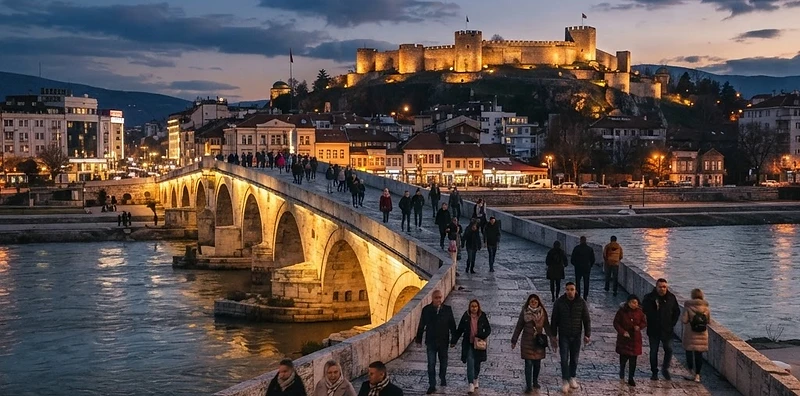
North Macedonia
A multi-ethnic state with an official language regime reflecting the Ohrid Framework Agreement.
Local name: Северна Македонија
Recognised regional or minority languages: Turkish, Romani, Serbian, Bosnian, Aromanian
Source labels and dataset codes are those published by the statistical authority named on each row. Figures are reproduced as retrieved, without interpolation.
North Macedonia, known locally as Северна Македонија, is a landlocked country situated in the central Balkan Peninsula. The nation recognizes Macedonian and Albanian as official languages, while Turkish, Romani, Serbian, Bosnian, and Aromanian are protected as regional or minority languages under the Council of Europe Charter. Its capital and largest city is Skopje. The country is defined by its complex multi-ethnic social fabric, a history of transition from a socialist republic to an independent parliamentary democracy, and a cultural identity deeply rooted in the intersection of Byzantine, Ottoman, and Slavic influences. Demographic continuity is currently shaped by significant outward migration trends and a demographic transition characterized by an aging population and low fertility rates. These structural factors influence the national approach to social policy, economic development, and the preservation of its diverse intangible cultural heritage within the broader European context.
UNESCO Intangible Cultural Heritage: Traditional bagpipe (Gayda/Tulum) making and performing · Spring celebration, Hıdrellez · Cultural practices associated to the 1st of March · Glasoechko, male two-part singing in Dolni Polog · Kopachkata, a social dance from the village of Dramche, Pijanec · Feast of the Holy Forty Martyrs in Štip

Strategy for Demographic Policies 2024-2044
This strategy provides a comprehensive framework for addressing demographic challenges in North Macedonia, including population aging and migration. It incorporates long-term population projections through 2070 to guide evidence-based policy interventions.
- Instrument
- Strategy
- Year
- 2024
- Scope
- North Macedonia national policy