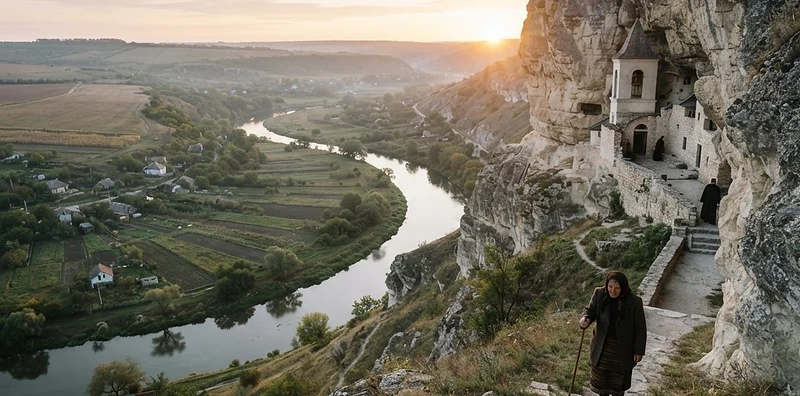
Moldova
A small state with one of Europe's steepest population declines, driven by emigration and a frozen conflict.
Local name: Moldova
Recognised regional or minority languages: Russian, Ukrainian, Gagauz, Bulgarian, Romani
Source labels and dataset codes are those published by the statistical authority named on each row. Figures are reproduced as retrieved, without interpolation.
Moldova (local name: Moldova) is a landlocked country in Eastern Europe, with its capital in Chișinău. The official language is Romanian, while the country recognizes Russian, Ukrainian, Gagauz, Bulgarian, and Romani as regional or minority languages under the Council of Europe Charter. Moldova is characterized by a high degree of rurality, with over half of its population residing in rural areas, and a demographic profile shaped by significant outward migration and a long-term decline in total population since the late 1980s. Culturally, the nation maintains strong continuity through its agrarian traditions and a rich heritage of folk crafts, which serve as vital markers of identity. The country's demographic landscape is further defined by an aging population and a persistent concentration of economic and social activity within the capital city, which accounts for nearly a quarter of the total national population.
UNESCO Intangible Cultural Heritage: Cultural practices associated to the 1st of March · Traditional wall-carpet craftsmanship in Romania and the Republic of Moldova · The art of the traditional blouse with embroidery on the shoulder (altiță) — an element of cultural identity in Romania and the Republic of Moldova · Cobza, traditional knowledge, skills and music

Law on Folk Artistic Crafts
This law establishes the legal framework for the protection and promotion of traditional crafts in Moldova. It provides mechanisms for supporting artisans and ensuring the transmission of traditional skills to future generations.
- Instrument
- Law
- Year
- 2003
- Scope
- Moldova national policy