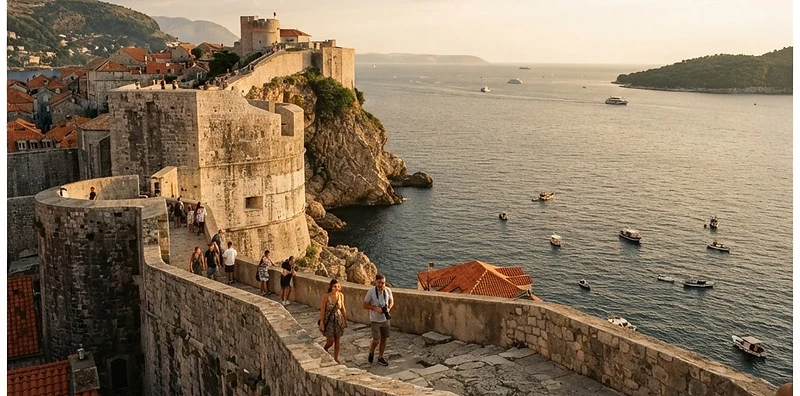
Croatia
An Adriatic EU member with extreme island depopulation and a heritage economy driven by coastal tourism.
Local name: Hrvatska
Recognised regional or minority languages: Serbian, Italian, Hungarian, Czech, Romani, Slovene
Source labels and dataset codes are those published by the statistical authority named on each row. Figures are reproduced as retrieved, without interpolation.
The Republic of Croatia, known locally as Hrvatska, is a parliamentary republic situated in Central and Southeast Europe, bordering the Adriatic Sea. Its capital and largest city is Zagreb. The official language is Croatian, while the Council of Europe Charter for Regional or Minority Languages recognises Serbian, Italian, Hungarian, Czech, Romani, and Slovene as minority languages in specific administrative areas. Croatia is defined by its deep historical integration into the Mediterranean and Central European cultural spheres, which is reflected in its architectural heritage and social traditions. Demographically, the country is characterised by a process of continuous population ageing and a long-term trend of negative natural change, which has been partially offset in recent years by positive net migration. These structural shifts are central to the nation's current demographic and cultural continuity, as the state balances the preservation of its traditional identity with the challenges of a modern, integrated European society.
UNESCO Intangible Cultural Heritage: Klapa multipart singing of Dalmatia, southern Croatia · Bećarac singing and playing from Eastern Croatia · Nijemo Kolo, silent circle dance of the Dalmatian hinterland · Mediterranean diet · Art of dry stone construction, knowledge and techniques · Lipizzan horse breeding traditions · Transhumance, the seasonal droving of livestock · Ojkanje singing

Strategy for the Development of Culture of the Republic of Croatia
This strategy outlines the national framework for the protection, promotion, and sustainable development of cultural heritage. It emphasises the integration of cultural policy with social and economic development goals to ensure the continuity of Croatian cultural identity.
- Instrument
- Strategy
- Year
- 2021
- Scope
- Croatia national policy